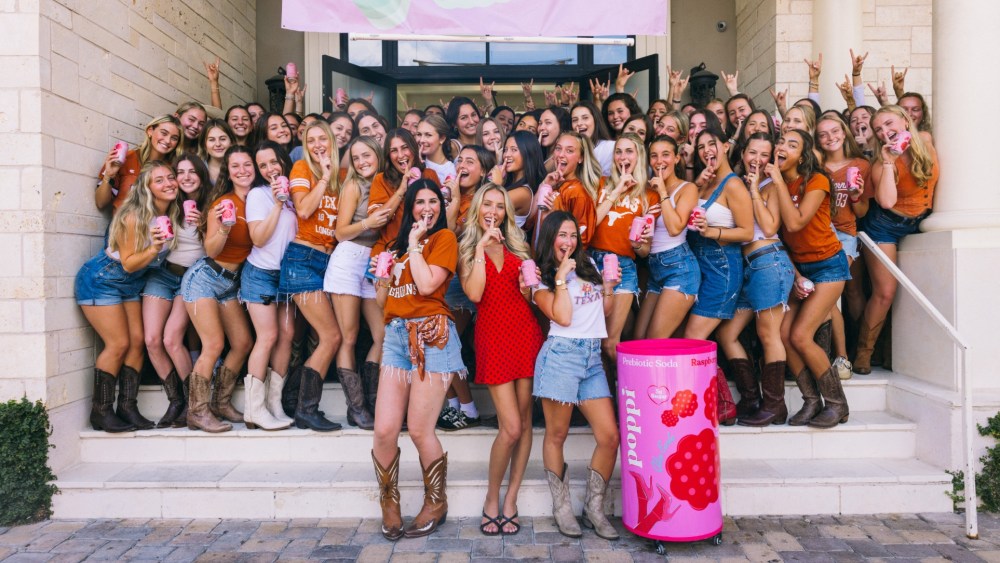
This past fall semester, there’s been some new additions as well as a few returning favorites on college campuses: beauty and wellness brands.
From Bath & Body Works, Ulta Beauty, Sephora to Bubble and Poppi, beauty and wellness brands are popping up at colleges across the country more than ever before in many ways.
The reason? With brands increasing their focus on Gen Z consumers, colleges have become a crucial place for many to market.
“Over 75 percent of folks around that just-before-college age are already using skin care and fragrance on a daily basis and are spending 50 percent more than prior generations, and 60 percent of them are already buying prestige. Even teen boys are buying prestige fragrance,” Jeff Lindquist, a partner in Boston Consulting Group’s New York office, said.
BCG’s research found that teens spend about $5 billion annually in the beauty category. The average age for the cohort’s entry into skin care is 12 years old; for makeup, it’s 13 years old, and in fragrance, just 11 years old. This goes for both boys and girls.
“College is the moment to lock in those prestige-, masstige-leaning young adults who are just starting to build these routines and convert that trial into long-term loyalty, and it’s a way that you can do so, with very efficient distribution and customer acquisition cost, because it’s all done on campus,” added Lindquist.
Per Kim Johnson, a director at Next Gen, United Talent Agency’s marketing division, another reason behind the increase in activity is that for a few years during and post pandemic, many students were remote.
“During 2020 through probably 2023-ish, we saw less IRL activation on college campuses, and a lot of brands were really focused on social and content,” she said. “We’re seeing brands come back to how important it is to have an in-person presence on college campuses. A lot of it is maximizing the opportunity of what a college campus is in so many ways — these little communities, some feel like little cities. The ability for brands to really show up and have a presence on campus is something that you really can’t replicate even through social or through content.”
Bubble Skincare, founded by Shai Eisenman in 2020, began working with colleges in 2023 and now has 15,000 college ambassadors through its Bubble on Campus program. The ambassadors promote Bubble products on campus through social media and events and in return earn commission on sales made with their promo code, and unlock rewards such as free products, gift cards, cash, among other perks. How they promote Bubble is largely up to the ambassadors themselves. In addition, the brand taps 10 college reps per semester, which Bubble describes as an elevated version of an ambassador as there are more requirements such as hosting events and bringing Bubble to life on their campus in a more structured way.
“College campuses are culture centers. You have so many students in this fresh chapter of their lives, and they’re driving their own culture on this college campus,” Marianne Robinson, senior director of community and influencer at Bubble, said. “If Bubble has a strong presence on a campus, we’re going to build the trust with the students. That’s something that’s made us really successful and has helped us realize why college is so important. Because not only are we showing up in culture, which makes us feel really relevant to a college student, but it’s also that peer recommendation piece. So we don’t target them with ads. We’re not really trying to get them through paid marketing and advertisements. We’re letting them do the work. Here’s this brand, here’s why we think you’d love it. Here are the tools you need. And we’re letting the students take Bubble through their college campuses.”

Bubble on campus.
Courtesy
The ambassadorship just launched in the U.K., while Bubble recently took its U.S. college engagement a step further with its Face the Future scholarship, where a total of 21 applicants receive scholarships up to $1,000, $3,000, $5,000 and $7,500, while a Bubble ambassador receives $10,000.
“It’s open to prospective college students, too, so you don’t have to be in college to win it. You could be going into college,” added Robinson. “One of my favorite things that Bubble did with the scholarship program was it wasn’t just used toward tuition. We understand that so many different expenses come with going to school. So if they needed a new laptop, if they wanted to pay for a graphic design course. It was really about, what do you need to continue your education?”
Elsewhere, beauty retailers have been showing up to campus in different ways. In August, Bath & Body Works announced plans to sell products such as body and lip care, hand soap, wallflower heaters and bulbs, candles and sanitizers in more than 600 campus stores, marking the first time it has ever distributed products at this scale outside its own stores.
“It was important for Bath & Body Works to expand into college campuses as it allows us to reach our Gen Z customers where they are and when they need us most,” said Betsy Schumacher, chief merchandising officer at Bath & Body Works.
Ulta Beauty, meanwhile, launched its College Glow Up Tour in partnership with HerCampus Media. It ran from Sept. 16 to 26, with a custom Ulta Beauty truck stopping at six campuses, featuring free treats, photo opportunities, product gifts, influencer meet-and-greets, branded merchandise and other giveaways. Students also had the chance to sign up for the Ulta Beauty Rewards Program and new Student Perks to earn more points.

Ulta Beauty
Dream Girl Shot It
That same month, Kohl’s partnered with Sephora to launch an interactive Sephora at Kohl’s “Beauty Corner” experience at the University of Tennessee, University of Georgia, and University of Florida as Sorority Recruitment Week took over college campuses. Across all three campuses, the Sephora at Kohl’s “Beauty Corner” offered makeup and hair touch-ups and product giveaways.
“Rush Week sparks a dynamic social conversation each year, and we saw an opportunity to meet Gen Z where they’re already engaging,“ said Christie Raymond, Kohl’s chief marketing officer. “By bringing Sephora at Kohl’s directly to campus with the Beauty Corner experience, we’re connecting with students where they live and socialize.”
In the wider wellness category, it’s a similar story. Poppi, which was acquired by PepsiCo for $1.95 billion in March, has doubled down on college students, offering four monthlong ambassador programs, seeding product and hosting on-campus activations with talent like Love Island’s JaNa Craig and Amaya Espinal and internet personalities like Jake Shane and Alix Earle.

JaNa Craig at Spelman for Poppi.
Courtesy of Poppi
“This audience is essential for Poppi as it’s where cultural trends start and long-term loyalty with a digital-first generation is built,” said Caroline Taylor, director of collegiate and ambassador relations at Poppi. “They share everything they do online, quickly adopt (or at least try!) trends and provide authentic word of mouth.”
Poppi has seen major success with this approach. According to the brand, it has reached more than 38 million consumers through its ambassador program and on-campus activations. To increase its relevance on college campuses, Poppi has partnered heavily with Alix Earle, who is an investor in the brand. Earle recently surprised students in sororities at University of Texas at Austin, following the announcement of the Alix Earle paid internship at Poppi. According to the brand, they received more than 4,000 applications for the internship and accepted six students.

Amaya Espinal at Penn State for Poppi.
Courtesy of Poppi
With Jeff Rubenstein, former president and chief growth officer at Poppi, now at the helm of Khloé Kardashian’s snack line Khloud, the brand is taking a similar approach. Like Poppi, Khloud is tapping into Greek life in particular on college campuses, which has become a cultural phenomenon following the rise of RushTok showcasing girls getting ready and going through the process of sorority rush.
“We’re tapping into the sorority community in a big way,” said Rubenstein. “[They’re] embracing this brand in a major way. We’re seeing students fall in love with the concept, partially because they are fans of Khloé’s, but also because they’re loving the idea that there’s an approachable, right-sized protein product that fits their lifestyle.”
Khloud senior director of marketing Tate Murray added: “We’ll be increasing college seeding to drive trial and awareness, scaling micro-influencer partnerships and building out a dedicated college e-commerce strategy to make it easier for students to discover and purchase Khloud online.”
BCG’s Lindquist believes that tapping college micro influencers like those on RushTok or college athletes is an effective marketing tool for Gen Z.
“If you think about a college campus and you’re seeing a micro celebrity on campus or a student athlete that’s promoting something, or partnering and sharing, that actually feels more like the advice of a friend, and they’re more willing to accept that, versus something that feels more like a paid advertisemens on digital or the advice of a sales associate in-store,” he said. “There’s a bit of authenticity to your community, your friend group.”

Kendall Jenner hosting an 818 tailgate.
Courtesy of 818
In addition to this, though, talent-led events have become the norm on college campuses to drive hype and brand awareness. Outside of beauty and wellness, Kendall Jenner’s tequila brand 818 in particular has seen success tapping into party culture. 818 has hosted bars, where talent including Jenner herself, are mixing drinks for students to try, and most recently a tailgate pop-up in Texas for the University of Texas vs. University of Oklahoma football game, historically known as the Red River Rivalry.

818 tailgate
Courtesy of 818
“The 818 College Tour has kept building through 2025 and helped shape a new way to reach college consumers and talent,” said 818 chief marketing officer Kathleen Braine. “We’re now focused on deepening our presence in key campus markets and building a strong, legal-drinking-age community around the brand. Legal-drinking-age college consumers are major drivers of culture and brand discovery. They over-index on social sharing, trend adoption and word of mouth.”
Meanwhile, brands like Stoney Clover Lane, known for its personalized accessories, and Lola Blankets, known for its influencer-favorite blanket, are tapping into the market with targeted collections. Stoney Clover Lane, specifically, offers customizable merchandise for a variety of colleges like University of Georgia, University of Texas at Austin and Tulane University. To maintain this customer’s loyalty, Stoney Clover Lane has also hosted shops-in-shop in college bookstores for more than three years.

Stoney Clover Lane merchandise.
Courtesy of Stoney Clover Lane
“Game day is a major cultural moment, and our bags let students show school spirit in a way that’s elevated and uniquely their own through customization,” said Stoney Clover Lane cofounder Kendall Glazer. “Every time we launch a new school or activate on a campus, we see an immediate lift in engagement and sales.”
The impact in marketing to this age group has been significant, per Glazer.
“College girls are influencers within their own communities,” she said.
Meanwhile, Lola Blankets recently released its dorm collection, which features pillows and blankets in vibrant colors and fit for smaller spaces.

Lola Blankets dorm collection.
Courtesy of Lola Blankets
“The college market has been one of our strongest word-of-mouth personas. It is a demographic that not only buys the product, but shares it, posts about it, and brings new people into the brand,” said Samantha Forrest, head of brand at Lola Blankets. “Launching the Lola Dorm Collection this year was a major turning point. It was the first time we built a collection specifically for the college audience, featuring dorm-ready colors.”
Johnson, for one, believes these brands are on the right track when it comes to capturing this audience.
“One of the biggest challenges is capturing attention for college students,” she said. “They’re really busy. There’s so many things happening on campus. One of the things that brands are really starting to tap into is it’s more than putting up a flyer on campus or hosting a small event with a bunch of students. It really is showing up with the brand’s full presence in order to really make a splash. You have to show up really thoughtfully and really intentionally in order to capture their attention.”
#Beauty #Wellness #Brands #Targeting #Colleges #Win #Gen
