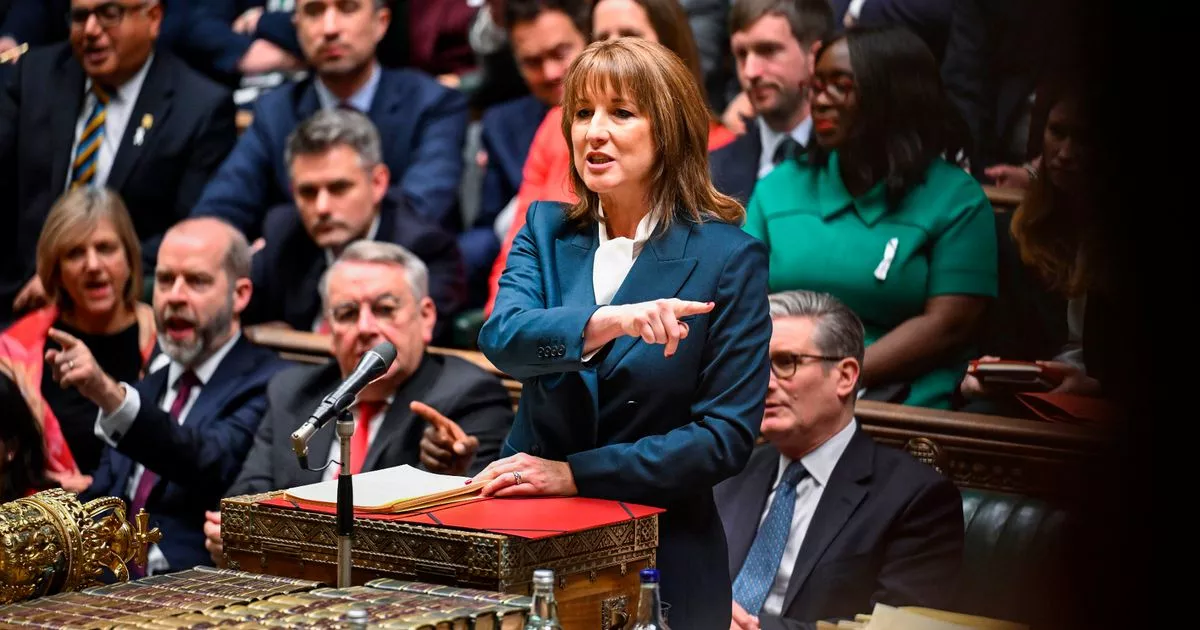
“While ministers in London insist this is a Budget for working people, it’s hard to square that claim with policies that make it harder for employers to keep staff and grow.”
Budgets often reveal more in their silences than in their headlines. and Rachel Reeves’ second Budget, which was presented as a steadying hand after a period of economic turbulence, offers Northern Ireland a familiar mix of modest allocations and cautious promises. But stripped of the rhetoric, it is difficult to avoid the conclusion that this Budget lacks any serious plan for growth and Northern Ireland will feel that absence acutely.
The contrast with Dublin is instructive. In their most recent budget, the Irish Government cut VAT for food, catering and hairdressing from 13.5% to 9%. Here it remains at 20%. For hospitality and personal services already straining under rising wages, energy costs and higher employer National Insurance contributions, a similar reduction could have offered meaningful breathing room. Instead, firms are left carrying rising costs alone, while ministers in London insist this is a Budget for working people. It’s hard to square that claim with policies that make it harder for employers to keep staff and grow.
There are other notable omissions. The PSNI data breach, which was one of the most serious security failures in the region’s history, receives no additional funding support. The Executive must absorb its impact within already stretched budgets, even as departmental pressures this year alone are estimated at around £400 million. Reeves may talk about stability, but for Northern Ireland, the Budget delivers little more than managed decline.
The Chancellor’s promise to cut household bills also raises more questions than answers. Much of what has been announced applies only to Great Britain, not Northern Ireland’s distinct energy market. Consumers here have learned to be sceptical of big-picture claims that quietly omit the fine print.
Perhaps the clearest example of the Budget’s lack of candour lies in its approach to tax. Reeves insists she has protected “working people” from tax rises, yet she continues a freeze on income tax thresholds that will drag thousands more Northern Ireland workers into higher tax bands or into paying tax for the first time.
This fiscal drag is a tax rise by stealth. Pay packets may be rising on paper due to inflation-driven adjustments and a higher National Living Wage, but real incomes remain under pressure. More people will pay more tax without feeling any better off. In a region where wages remain well below UK averages, this approach feels less like fairness and more like opportunism.
On welfare, the Government has offered to fund the removal of the two-child limit and to cover pension uprates if the Executive chooses to follow suit which are both likely to gain traction locally. There is also fresh encouragement to tackle welfare fraud and error, with the Executive promised a percentage of any savings. But this is not new money. It is simply an invitation for Stormont to do more of the Treasury’s work in order to secure modest returns, which had already been agreed a decade ago at the Fresh Start Agreement, but was never implemented.
The wider funding picture is equally thin. The Executive will receive an extra £370 million over the Spending Review period of between three and four years. While yes, this money is useful, it is hardly transformational. The fact that Northern Ireland continues to receive more per head than England is often cited as reassurance, yet the state of our public services tells its own story. Even with the uplift, Stormont faces a decade of budgetary firefighting.
On the economic front, the Budget gestures toward ambition without delivering it. The £16.6 million Internal Market Package, the expansion of Intertrade UK and the confirmation of advanced manufacturing as the focus for the Enhanced Investment Zone all sound positive. But taken together, they amount to a handful of small-scale interventions rather than a coherent growth strategy. The much-heralded investment zone is expected to generate around 1,000 jobs over ten years, which is certainly helpful, but not the kind of step change Northern Ireland needs.
Businesses, meanwhile, face rising wage costs without any significant offsetting support. The next increases in the National Living Wage and Minimum Wage will benefit workers but impose further pressure on employers. Without measures such as a targeted VAT reduction or reliefs for small firms, growth is likely to slow rather than accelerate.
The Executive now has the unenviable task of producing a multi-year budget that must move beyond crisis management. As the think-tank Pivotal notes, this should be a moment to reassess priorities and focus on public sector transformation. However, this becomes far more challenging when Westminster’s budget offers no real engine for economic expansion.
Rachel Reeves may believe she is delivering stability. From Northern Ireland, the picture looks more like stagnation dressed up as caution. The Budget’s quiet tax rises, lack of support for struggling sectors and absence of a credible growth plan leave too many unanswered questions.
Northern Ireland is a region with low productivity, a fragile private sector and strained public services, and we needed a bold push for growth. What we received instead was a Budget that manages the present while avoiding the future.
For all the latest news, visit the Belfast Live homepage here and sign up to our politics newsletter here.
#Labours #taxraising #Budget #offers #return
