Death.
Taxes.
That’s because Samsung’s most coveted devices, the high-end Galaxy S Ultra flagships, have constantly featured batteries with a 5,000 mAh capacity ever since their debut in early 2020. Seasons changed, pandemics came and went away,
Don’t get me wrong, back in 2020 a 5,000 mAh battery was not too shabby at all and was actually among the best-endowed flagship phones out there. I was particularly impressed with the Galaxy S20 Ultra’s battery size and battery life, respectively, but now, nearly six years in, this initial interest has transformed to boredom.
Here’s the rise of Apple’s battery capacity increase compared to Samsung’s constant use of similarly sized batteries.
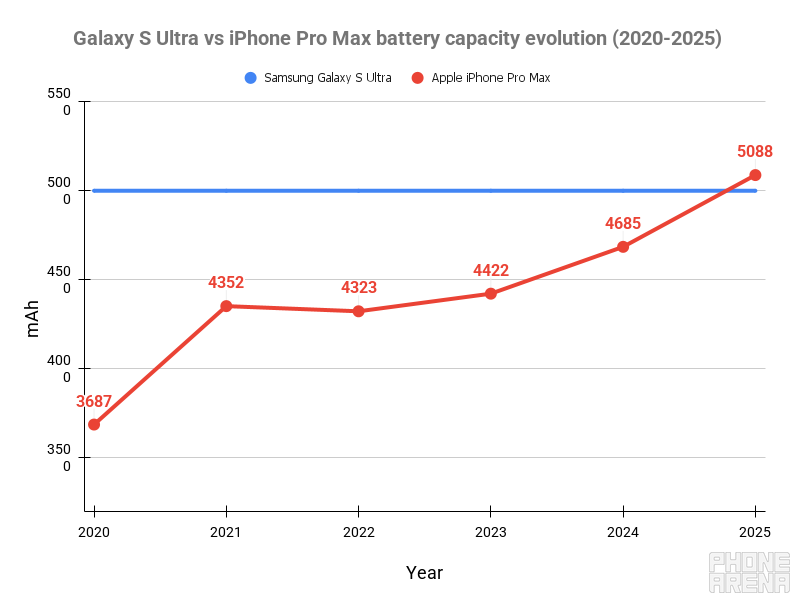
A chart comparing the battery capacities of Samsung and Apple’s flagships between 2020 and 2025 (Image by PhoneArena)
Do battery capacities even matter these days?
I get it; there’s much more to battery life than battery capacity alone. Efficiency is key, and we’ve scored even bigger gains in the past few years. The same applies to Samsung. Even though I love rubbing in the fact that Galaxy S Ultra flagships always come with a 5,000 mAh battery, I can’t deny that the optimization and efficiency of Samsung’s flagships have been perfected greatly, and as a result, the battery life has increased exponentially across the board.
Here’s how Samsung’s flagship phones have fared in our custom battery tests over the years, and it’s clear to notice the upward trend in overall efficiency. The consistency of that battery life is striking: every generation has better battery life, with the biggest jump being from the Galaxy S22 Ultra to the Galaxy S23 Ultra.
That’s definitely more inconsistent than what Samsung’s flagships achieve.
And here are the two device lineups compared against one another.
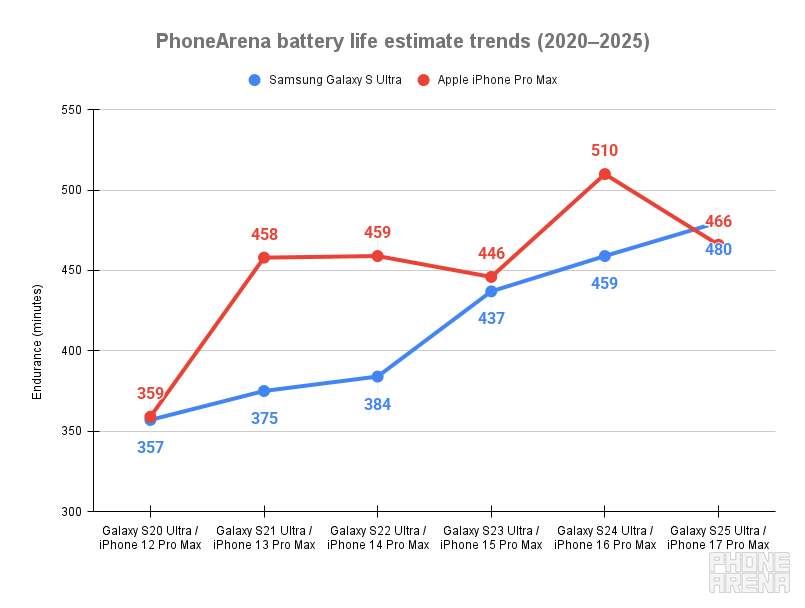
A chart comparing the battery life of Samsung and Apple’s flagships between 2020 and 2025 (Image by PhoneArena)
So, overall, despite Samsung’s reluctance to go big in terms of battery size, the company has so far successfully fared well with the same-sized 5,000 mAh battery, extending the battery life further with each generation.
The historic Galaxy Note 7 curse
One of the reasons why Samsung is playing it much safer with battery sizes these days could be traced back to the Galaxy Note 7 a decade ago, in 2016. This notorious device had an unfortunate battery design flaw that caused multiple units to catch on fire and pose serious risks to its users. It’s also at the top of the list of phones that have ever been banned from being on you, your checked-in, or carry-on luggage on plane flights in the US, Asia, Australia, and Europe.
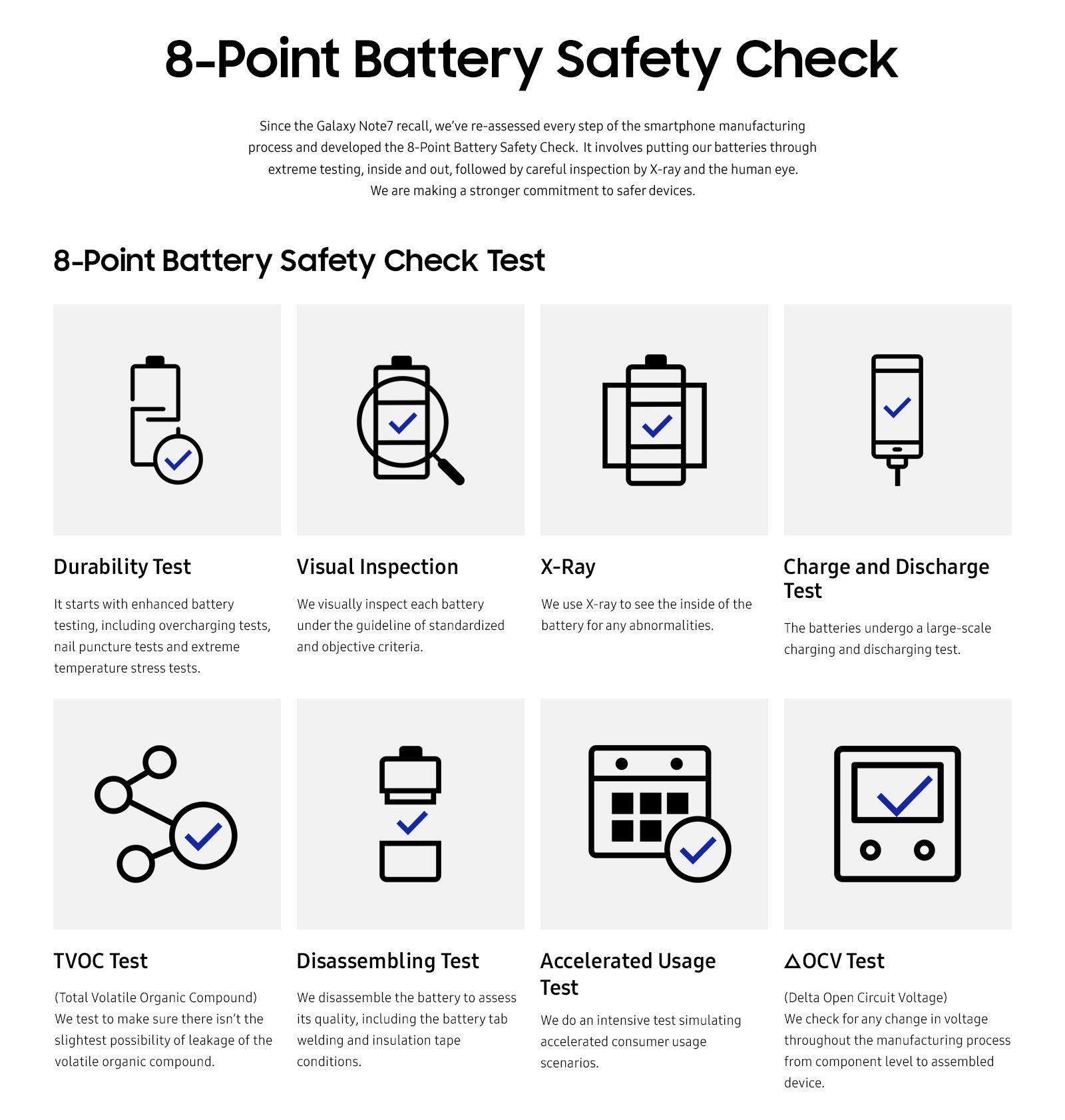
Samsung’s extensive 8-point battery testing system (Image Credit – Samsung)
However, that’s not the real reason why Samsung phones have batteries in the 5,000 mAh. As usual, there’s more.
It’s all about the law, man
Samsung did nothing wrong
In my opinion, the fact that all Galaxy S Ultra phones come with 5,000 mAh batteries isn’t such big of a deal. We’ve already proved that despite the battery not having grown in the past six years, battery life has gradually increased.
While I get excited at the prospect of a Galaxy Ultra flagship with a 7,000 mAh silicon-carbon battery as much as the next nerd, it’s unlikely that this is happening anytime soon.
In fact, rumors about the Samsung Galaxy S26 Ultra, which is due in a couple of months, indicate that we will be getting a 5,000 mAh battery once again. Let’s hope that the upward battery endurance trend continues with that one, and we get even better battery life.
#Samsungs #mAh #battery #hasnt #changed #years #Apple #finally #caught
