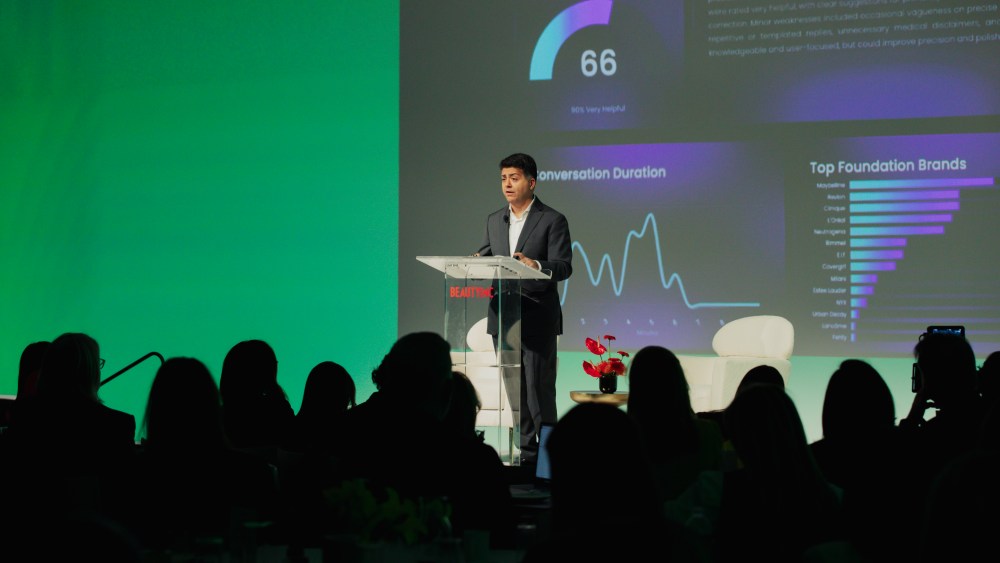
Parham Aarabi, chief executive officer and founder of Pre, took to the 2025 WWD Beauty Inc Catalyst stage to examine how beauty product discovery is being influenced through ChatGPT, Google Gemini and Amazon’s AI assistant Rufus.
More and more, beauty brands need to measure their AI visibility, including how often they’re recommended on AI platforms. One of the biggest challenges for brands remains how to improve AI visibility when it typically takes brands three to six months to change their content online and another three to six months of AI training update to see any real impact.
Pre uses a simulation to run thousands of shopper conversations on the top platforms to see what recommendations are being made.
It’s a trick that some beauty brands are already using to optimize in real time.
“Imagine you had a crystal ball, and you can actually — any direction you want to implement any ad campaign, even product information you want to change — what if you could actually test it in a matter of minutes to see, is it going to work and how effective is it going to be for your brand or ineffective?” said Aarabi.
Through the simulation Pre ran, Aarabi looked at data from the week of Nov. 9 to 15. The top skin care brands ChatGPT recommended in the U.S. were The Ordinary, CeraVe, Paula’s Choice, La Roche-Posay, UltaMD and Vanicream. The top fragrance brands ChatGPT recommended in the U.S. were Sephora, Jo Malone, Diptyque, Maison Frances, Le Labo and Maison Margiela. The top hair care brands ChatGPT recommended in the U.S. were Olaplex, Redken, L’Oreal, Wella, Clario and Garnier. And the top makeup brands ChatGPT recommended in the U.S. were Fenty Beauty, Estée Lauder, Clinique, Maybelline, Nars and Urban Decay.
Pre also tests how ChatGPT or Gemini respond to changes in content — including product descriptions, user questions and answers, SEO strategies, reviews or comparison between brands and products. Aarabi said the system predicts the effectiveness of a new strategy in 30 minutes, while most guesswork for ad campaigns can take months. This allows brands to test a variety of different approaches before a big launch.
One example Aarabi pointed to was a skin care brand whose main competitors are Olay and CeraVe — with an 8 percent lower rate of recommendation. The simulation used multiple strategies when testing, such as positive reviews, SEO, product ingredient content and user-centric Q&As to improve its recommendations on AI platforms.
At the end, the company used a combination of user Q&A and competitive comparison and the brand saw a 10 percent improvement over its competitors. The entire testing was done in 24 hours, allowing for brands to consistently grow and experiment on what works for various AI platforms.
“Imagine if this agent is running seven days, a whole month or on an ongoing basis. Imagine the impact you can have on AI visibility,” said Aarabi.
#Visibility #Tools #Boost #Beauty #Brand #Impact
