The future of beauty is all about formulation.
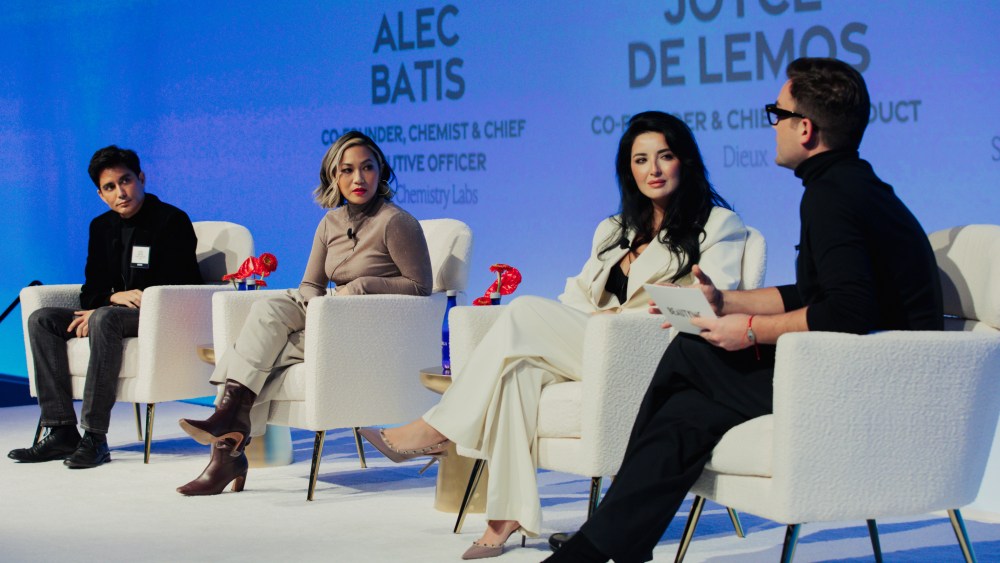
At WWD’s inaugural The Catalysts event in New York City, Dieux’s Joyce de Lemos, Sick Science’s Dr. Polen Koçak, PhD, and Sweet Chemistry’s Alec Batis sat down with beauty market editor James Manso to discuss their approach to formulating, how AI is impacting future products and what the next big beauty innovations could be.
As with most industries, the conversation landed on AI and how it can be employed throughout beauty brands.
“It’s a powerful tool that I would definitely incorporate in the future of formulation. Right now, I would say AI is as good as the input and the data that you’re putting into it. From a formulator perspective, formulations require so much tactile sensitivity,” said de Lemos. “There’s a lot of real-time data that needs to be generated and harnessed by all these tools. I don’t know that we’re there yet.”
However, both de Lemos and Koçak agreed the technology is helpful in analysis.
“We use AI, not for product development, but it helps us to analyze at scale,” said Koçak. “For example, we analyze thousands of plants, but now AI helps us to formulate a combination of different types of plant exosomes, as well as if we want to capsulate active materials inside of the exosomes. With AI, it’s easier, smarter, faster.”
De Lemos added: “I love the idea of using it to talk to our community, to gain insights, to discover need states… From a formulation perspective, I liken it to telling a Michelin chef, ‘Can you create an AI recipe?’ or them using an AI recipe. There’s the tasting, the feeling, the creativity behind it. There’s such a human aspect to it that I’m going to have to evaluate the equivalency there before I can completely subscribe to it.”
For Batis, AI is leading to a shift in how consumers pick products.
“For a long time, beauty was secret ingredients or secret raw materials, how it’s manufactured, all that was behind the curtain…. Now you can just throw into AI the peptide from the ingredient list, ask how many brands that this peptide is in, and it’s in 1000s around the world. You can find out quickly a little bit of the marketing stuff [the industry has] been doing,” he said. “Because of AI, it’s time to evolve and then make sure that our formulas are ticked and tied, and we’re saying what’s actually in them and communicating with the customer what they’re getting for the price that they’re paying.”
With artificial intelligence, social media and a slew of brands to choose from, consumers are also smarter than ever. Therefore, a brand’s value proposition is crucial.
“They’re going to want to feel like they have purchasing power,” said de Lemos. “It’s up to us to educate on that, so the need state there is, as a brand, to be able to deliver cost-effective formulations.”
Koçak added: “Consumers want to see real results [and] real science. That’s why education is important. We try to translate complex, biotechnologic, scientific buzz words into everyday skin care… We try to show lab imagery, before and afters, [to give] consumers results and try to educate in an understandable way.”
To close out the conversation, each panelist shared what they thought beauty’s next big innovation was going to be. For Koçak, the future is all about products that use cell communication. De Lemos is looking forward to “sunscreens that are just as elegant as everything that we can get internationally,” and Batis is predicting a future of “new technologies in regenerative medicine and regenerative farming and the abolishment of the use of marketing levels in our industry.”
#Formulators #Discuss #Beautys #Big #Innovation
